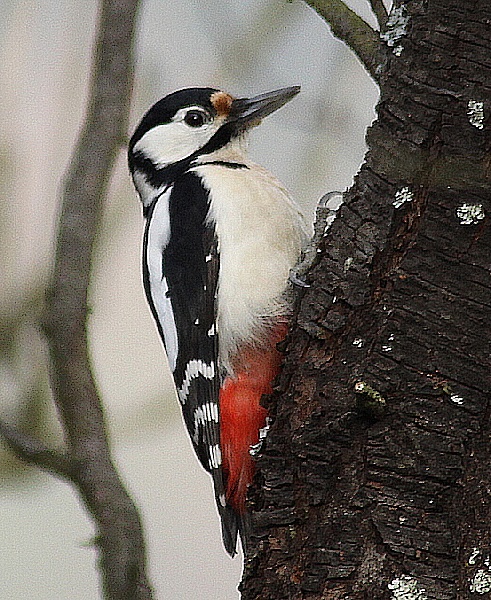
Dendrocopos major · ďateľ veľký · Great Spotted Woodpecker
Alternative and historical names
Slovak names
- ďateľ veľký (Kovalik 2010)
- ďatel (strakatý) veľký (Kovalik 2010)
- ďateľ strakatý (Kovalik 2010)
- ďateľ veľký (Matoušek 1990)
English names
- Great Spotted Woodpecker (IOC 2.5 2010)
- Great Spotted Woodpecker (BOU 1923)
Scientific names
- Dendrocopos major (AviList 2026)
- Dendrocopos major (IOC 15.2 2026)
- Dendrocopos major (IOC 2.5 2010)
- Dryobates major (BOU 1923)
Taxonomic synonyms
- Dryocopus major (Dabenne, 1916)
- Picoides major (Linnaeus, 1758)
- Picus major (Linnaeus, 1758)
- Dendrocopos major (Linnaeus, 1758)
Birding Slovakia database
This species through our community’s eyes
Species characteristics in Slovakia
- General occurrence
- resident / R
- Breeding
- common nidificant / Nc
- Wintering
- common wintering / Wc
- Rarities committee:
- Does not require any reporting or registration by Raritties commitee
Observation map

Detailed species observation statistics

Source: the Birding.sk database. Counts reflect observer contributions, not population size.
About this species
Distribution
The Great Spotted Woodpecker inhabits wooded parts of Europe, North Africa and Asia. It is Slovakia's commonest woodpecker and breeds regularly almost wherever suitable trees are available. It remains here throughout the year. In spring it draws attention by drumming; in winter it becomes more noticeable in gardens and at feeders too.
Habitat
Look for it in deciduous, mixed and coniferous woodland, larger parks, orchards and tree-lined avenues. Older trees, dry branches and decaying wood are valuable. Its loud call often reveals its presence before the bird is seen.
Breeding
The pair usually excavates a new hole in a trunk or substantial branch. In spring the female generally lays four to six white eggs. Both parents take part in incubation and feeding the chicks. Abandoned holes are later used by other birds and animals.
Food
It extracts insects and larvae from wood and beneath bark. Seeds of conifers and other trees become important in winter, and it may visit feeders for suet or nuts. Occasionally it takes other birds' eggs or nestlings.
Interesting fact
Rapid spring drumming is a means of communication and territorial advertisement. The woodpecker therefore chooses a surface that resonates well: as well as a dry branch, it may use a metal part of a building. The volume can be surprising for a bird of its size.
Sources: Slovak Wikipedia · BTO BirdFacts · English Wikipedia
Sign in to send private feedback on the text to our editors.
Explore further
Overview and identification
Descriptions, identification and names.
- Slovak Wikipedia ↗
Taxon account in Slovak: distribution, biology and references for further reading.
https://sk.wikipedia.org/wiki/%C4%8Eate%C4%BE_ve%C4%BEk%C3%BD - BTO BirdFacts ↗
Biology and identification in English; population figures and trends refer to Britain.
https://www.bto.org/learn/about-birds/birdfacts/great-spotted-woodpecker - English Wikipedia ↗
Taxon account in English: distribution, biology and taxonomic context.
https://en.wikipedia.org/wiki/Great_spotted_woodpecker - BTO: Identifying Great Spotted Woodpeckers and Lesser Spotted Woodpeckers ↗
English identification video comparing this taxon with similar species and explaining distinguishing features.
https://www.bto.org/learn/skills/bird-identification/videos/great-lesser-spotted-woodpeckers - Bird.watching.sk: identification and voice – Dendrocopos major ↗
Slovak species lesson describing appearance, voice and habitat, supporting field identification.
https://bird.watching.sk/sk/datel-velky-dendrocopos-major/