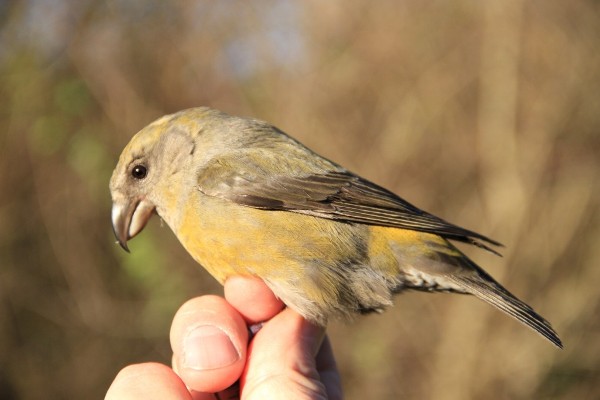
Loxia curvirostra · krivonos smrekový · Red Crossbill
Alternative and historical names
Slovak names
- krivonos smrekový (Kovalik 2010)
- krivonos obyčajný (Kovalik 2010)
- krivonos smrekový (Matoušek 1990)
English names
- Red Crossbill (IOC 2.5 2010)
- Crossbill (BOU 1923)
Scientific names
- Loxia curvirostra (AviList 2026)
- Loxia curvirostra (IOC 15.2 2026)
- Loxia curvirostra (IOC 2.5 2010)
- Loxia curvirostra (BOU 1923)
Taxonomic synonyms
- Loxia curvirostra reai (A.R.Phillips, 1981)
- Loxia curvirostra vividior (A.R.Phillips, 1981)
- Loxia curvirostra Linnaeus, 1758
Birding Slovakia database
This species through our community’s eyes
Species characteristics in Slovakia
- General occurrence
- mainly resident, minority is migratory / R(M)
- Breeding
- common nidificant / Nc
- Migration
- common transmigrant / Tc
- Wintering
- common wintering / Wc
- Rarities committee:
- Does not require any reporting or registration by Raritties commitee
Observation map

Detailed species observation statistics

Source: the Birding.sk database. Counts reflect observer contributions, not population size.
About this species
Distribution
The Common Crossbill inhabits Northern Hemisphere conifer forests, including European mountains. It is a regular Slovak breeder, especially in mountain spruce woods, but abundance and distribution change with cone crops. It may occur year-round, while food-driven movements also bring it to lower elevations and beyond usual breeding sites.
Habitat
Search spruce, pine and mixed forests, often high in seed-bearing trees. Flocks announce themselves with hard flight calls. They sometimes descend to drink or visit places where mineral material is available.
Breeding
The nest is well concealed in a conifer. Usually 3–4 eggs are laid; the male feeds the incubating female. Abundant seeds can allow winter breeding, so it does not follow only the usual spring timetable of songbirds.
Food
It specialises in conifer seeds, particularly spruce. The crossed bill tips force cone scales apart, allowing the tongue to extract the exposed seed.
Interesting fact
A chick’s bill is not fully crossed immediately after hatching. Until it develops into an effective cone-opening tool, the young crossbill depends on food supplied by its parents.
Sources: Slovak Wikipedia · English Wikipedia · BTO BirdFacts
Sign in to send private feedback on the text to our editors.
Explore further
Overview and identification
Descriptions, identification and names.
- Slovak Wikipedia ↗
Taxon account in Slovak: distribution, biology and references for further reading.
https://sk.wikipedia.org/wiki/Krivonos_smrekov%C3%BD - English Wikipedia ↗
Taxon account in English: distribution, biology and taxonomic context.
https://en.wikipedia.org/wiki/Red_crossbill - BTO BirdFacts ↗
Biology and identification in English; population figures and trends refer to Britain.
https://www.bto.org/learn/about-birds/birdfacts/common-crossbill
Data and research
Occurrences, distribution and research.
- SOC: identification of crossbills by calls ↗
English identification guidance with crossbill recordings and sonograms.
https://www.the-soc.org.uk/pages/identification-of-scottish-and-parrot-crossbills