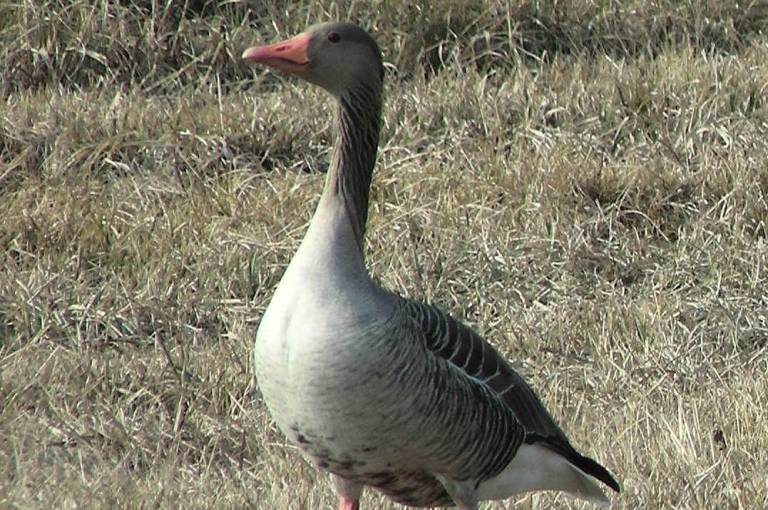
Anser anser · hus divá · Greylag Goose
Alternative and historical names
Slovak names
- hus divá (Kovalik 2010)
- hus divá (sivá) (Kovalik 2010)
- hus divá (Matoušek 1990)
- hus divá (Ferianc 1986)
English names
- Greylag Goose (IOC 2.5 2010)
- Grey-Lag Goose (BOU 1923)
Scientific names
- Anser anser (AviList 2026)
- Anser anser (IOC 15.2 2026)
- Anser anser (IOC 2.5 2010)
- Anser anser (BOU 1923)
Taxonomic synonyms
- Anser cinereus (Meyer, 1810)
- Anas anser (Linnaeus, 1758)
- Anser anser (Linnaeus, 1758)

Birding Slovakia database
This species through our community’s eyes
Species characteristics in Slovakia
- General occurrence
- migrant / M
- Breeding
- uncommon nidificant / Nu
- Migration
- common transmigrant / Tc
- Wintering
- common wintering / Wc
- Rarities committee:
- Does not require any reporting or registration by Raritties commitee
Observation map

Detailed species observation statistics

Source: the Birding.sk database. Counts reflect observer contributions, not population size.
About this species
Distribution
It occurs across much of Europe and Asia, with more northerly populations moving south for winter. In Slovakia it is a regular but local breeder, with important breeding areas in the west. It can form numerous flocks during migration and winter. Some birds remain near breeding areas when conditions are suitable.
Habitat
It needs wetlands with safe nesting sites and meadows or fields for grazing. It uses fishponds, gravel pits, river arms and islands. Large water bodies often serve as night roosts, while geese spread into the surrounding countryside to feed by day.
Breeding
It nests on the ground, on islands or in marginal vegetation. The female incubates while the male guards. Soon after hatching, the goslings move with their parents, which guide them to food and protect them from danger.
Food
It grazes grasses and herbs, takes seeds and uses agricultural crops and harvest residues. Water also provides a safe place to rest.
Interesting fact
It is the ancestor of most European domestic goose breeds. The similarity in their honking is therefore no coincidence; identification nevertheless needs to distinguish wild geese from domestic birds and their hybrids.
Sources: Slovak Wikipedia · English Wikipedia · BTO BirdFacts
Sign in to send private feedback on the text to our editors.
Explore further
Overview and identification
Descriptions, identification and names.
- Slovak Wikipedia ↗
Taxon account in Slovak: distribution, biology and references for further reading.
https://sk.wikipedia.org/wiki/Hus_div%C3%A1 - English Wikipedia ↗
Taxon account in English: distribution, biology and taxonomic context.
https://en.wikipedia.org/wiki/Greylag_goose - BTO BirdFacts ↗
Biology and identification in English; population figures and trends refer to Britain.
https://www.bto.org/learn/about-birds/birdfacts/greylag-goose - BTO: Identifying grey geese ↗
English identification video comparing this taxon with similar species and explaining distinguishing features.
https://www.bto.org/learn/skills/bird-identification/videos/grey-geese