Lymnocryptes minimus · močiarnička tichá · Jack Snipe
Alternative and historical names
Slovak names
- močiarnička tichá (Kovalik 2010)
- močiarnica tichá (Kovalik 2010)
- močiarnička malá (Kovalik 2010)
- sluka malá (Kovalik 2010)
- močiarnica tichá (Matoušek 1990)
English names
- Jack Snipe (IOC 2.5 2010)
- Jack Snipe (BOU 1923)
Scientific names
- Lymnocryptes minimus (AviList 2026)
- Lymnocryptes minimus (IOC 15.2 2026)
- Lymnocryptes minimus (IOC 2.5 2010)
- Lymnocryptes minimus (BOU 1923)
Taxonomic synonyms
- Gallinago gallinula (Linnaeus, 1766)
- Scolopax gallinula (Linnaeus, 1766)
- Galinago minima (Brünnich, 1764)
- Scolopax minima (Brünnich, 1764)
- Lymnocryptes minimus (Brünnich, 1764)
Birding Slovakia database
This species through our community’s eyes
Species characteristics in Slovakia
- Migration
- uncommon transmigrant / Tu
- Wintering
- uncommon wintering / Wu
- Rarities committee:
- Does not require any reporting or registration by Raritties commitee
Observation map

Detailed species observation statistics

Source: the Birding.sk database. Counts reflect observer contributions, not population size.
About this species
Distribution
Jack Snipe breeds in northern Europe and Asia and winters from western and southern Europe to Africa and southern Asia. In Slovakia it is a secretive spring and autumn migrant, with small numbers also wintering. Spring records are typical in March and April, autumn ones from September to November. It has no regular Slovak breeding population in summer.
Habitat
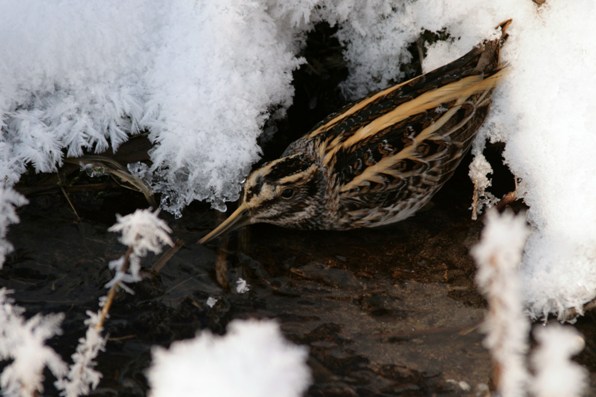
It seeks small muddy patches among sedges, waterlogged meadows and shallow fishpond margins. In winter it uses springs and unfrozen marshy ground. Even a tiny patch of soft mud within low vegetation can provide a suitable feeding stop.
Breeding
In its northern range it lays three or four eggs in a well-hidden ground nest. The male's aerial display includes a rhythmic sound resembling distant galloping; this is not winter behaviour of birds in Slovakia.
Food
It probes mud and picks insects, worms and other small invertebrates, supplementing these with plant material. Feeding birds often bob rhythmically.
Interesting fact
Relying on camouflage, it may remain crouched until a person is very close. Quiet, short flights distinguish it from Common Snipe; repeatedly flushing resting birds causes unnecessary disturbance.
Sources: Slovak Wikipedia · English Wikipedia
Sign in to send private feedback on the text to our editors.
Explore further
Overview and identification
Descriptions, identification and names.
- Slovak Wikipedia ↗
Taxon account in Slovak: distribution, biology and references for further reading.
https://sk.wikipedia.org/wiki/Mo%C4%8Diarni%C4%8Dka_tich%C3%A1 - English Wikipedia ↗
Taxon account in English: distribution, biology and taxonomic context.
https://en.wikipedia.org/wiki/Jack_snipe - BTO: Identifying Common Snipe and Jack Snipe ↗
English identification video comparing this taxon with similar species and explaining distinguishing features.
https://www.bto.org/learn/skills/bird-identification/videos/common-and-jack-snipe