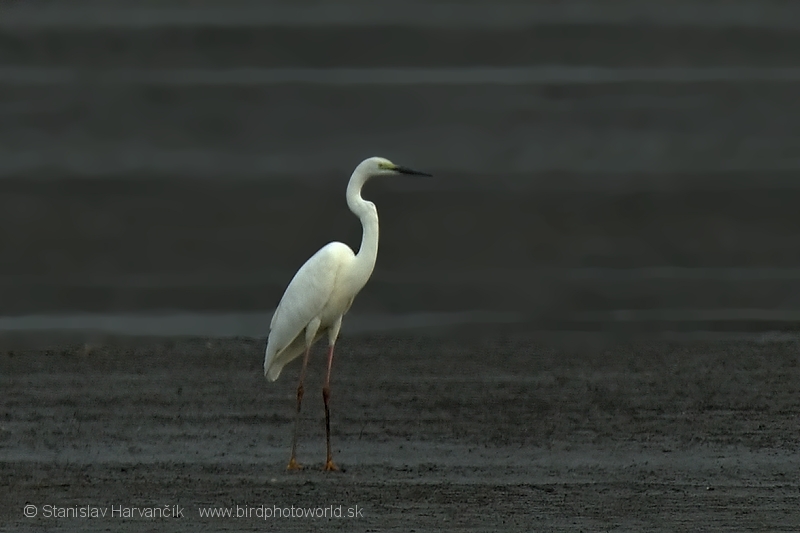
Ardea alba · beluša veľká · Great Egret
Alternative and historical names
Slovak names
- beluša veľká (Kovalik 2010)
- volavka biela (Kovalik 2010)
- volavka biela (Matoušek 1990)
English names
- Western Great Egret (IOC 2.5 2010)
- Great White Heron (BOU 1923)
Scientific names
- Ardea alba (AviList 2026)
- Ardea alba (IOC 15.2 2026)
- Ardea alba (IOC 2.5 2010)
- Egretta alba (BOU 1923)
Taxonomic synonyms
- Ardea alba checklist (, 1998)
- Casmerodius albus (Linnaeus, 1758)
- Egretta alba (Linnaeus, 1758)
- Ardea alba Linnaeus, 1758
Birding Slovakia database
This species through our community’s eyes
Species characteristics in Slovakia
- General occurrence
- migrant / M
- Breeding
- rare nidificant / Nr
- Migration
- common transmigrant / Tc
- Wintering
- uncommon wintering / Wu
- Rarities committee:
- Does not require any reporting or registration by Raritties commitee
Conservation — Red Lists
- Slovakia 2023breeding population
- Breeding population Period: 2013–2023 Source: Demko M. a kol. 2025: Červený zoznam vtákov Slovenska: aktualizácia 2013 – 2023. Tichodroma 37: 107–117. Online 18. 1. 2026. DOI: 10.31577/tichodroma.2025.37.18. Príloha 1, s. 116, riadok 20, stĺpec 6 Criteria: D1 Category downgraded by 1 level due to surrounding populations.
- Europe 2021
- Population scope unspecified Source: BirdLife International 2021: European Red List of Birds. Publications Office of the European Union, Luxembourg. Reported in: Demko M. a kol. 2025: Červený zoznam vtákov Slovenska: aktualizácia 2013 – 2023. Tichodroma 37: 107–117. Online 18. 1. 2026. DOI: 10.31577/tichodroma.2025.37.18. Príloha 1, s. 116, riadok 20, stĺpec 4
- World 2025
- Species Source: BirdLife International 2025: Species factsheets. Citované v Demko a kol. 2025, prístup 16. 4. 2025. Reported in: Demko M. a kol. 2025: Červený zoznam vtákov Slovenska: aktualizácia 2013 – 2023. Tichodroma 37: 107–117. Online 18. 1. 2026. DOI: 10.31577/tichodroma.2025.37.18. Príloha 1, s. 116, riadok 20, stĺpec 3
Previous assessments
- Slovakia 2013
- Breeding population Period: 2002–2012 Source: Demko M., Krištín A. & Pačenovský S. 2014: Červený zoznam vtákov Slovenska. SOS/BirdLife Slovensko, Bratislava. Zdroj stĺpca SK 2013 podľa poznámky 5 prílohy Demko a kol. 2025. Reported in: Demko M. a kol. 2025: Červený zoznam vtákov Slovenska: aktualizácia 2013 – 2023. Tichodroma 37: 107–117. Online 18. 1. 2026. DOI: 10.31577/tichodroma.2025.37.18. Príloha 1, s. 116, riadok 20, stĺpec 5 Category downgraded by 1 level due to surrounding populations.
Observation map

Detailed species observation statistics

Source: the Birding.sk database. Counts reflect observer contributions, not population size.
About this species
Distribution
Great Egret (Ardea alba), as treated on this card, includes the Asian and Australasian subspecies modesta. The species occupies warm and temperate regions of Europe, Asia, Africa, the Americas and Australia. In Slovakia it is a fairly common visitor to suitable open country, especially outside breeding; it breeds locally in wetlands and regularly winters here. Separate recording of “modesta-type” birds does not establish the presence of that subspecies in Slovakia.
Habitat
It can be seen at fishponds, river arms, reservoirs, flooded meadows and fields. It often stands well away from water hunting voles. Breeding nevertheless requires quiet wetland vegetation, while communal roosts may gather birds feeding across a wider area.
Breeding
It nests colonially in reeds or waterside trees and bushes, building from sticks and other plant material. Both parents incubate and bring food to the young. Suitable water conditions and undisturbed colonies matter more than the amount of surrounding farmland.
Food
It catches fish, amphibians, small mammals, insects and other available animals, waiting almost motionless or stalking slowly before striking with a rapid movement of the neck.
Interesting fact
Bill colour changes through the year. The normally yellow bill can become dark in the breeding season, so colour alone is insufficient to distinguish it from the Little Egret.
Sources: Slovak Wikipedia · English Wikipedia · BTO BirdFacts
Sign in to send private feedback on the text to our editors.
Explore further
Overview and identification
Descriptions, identification and names.
- Slovak Wikipedia ↗
Taxon account in Slovak: distribution, biology and references for further reading.
https://sk.wikipedia.org/wiki/Belu%C5%A1a_ve%C4%BEk%C3%A1 - English Wikipedia ↗
Taxon account in English: distribution, biology and taxonomic context.
https://en.wikipedia.org/wiki/Great_egret - BTO BirdFacts ↗
Biology and identification in English; population figures and trends refer to Britain.
https://www.bto.org/learn/about-birds/birdfacts/great-white-egret - BTO: Identifying Little Egret and Great White Egret ↗
English identification video comparing this taxon with similar species and explaining distinguishing features.
https://www.bto.org/learn/skills/bird-identification/videos/little-egret-and-great-white-egret
Data and research
Occurrences, distribution and research.
- State Nature Conservancy: identification, ecology and conservation – Ardea alba ↗
Slovak expert profile with morphology, ecology and species conservation information.
https://www.biomonitoring.sk/Registration/AtlasAnimal/Detail/48694