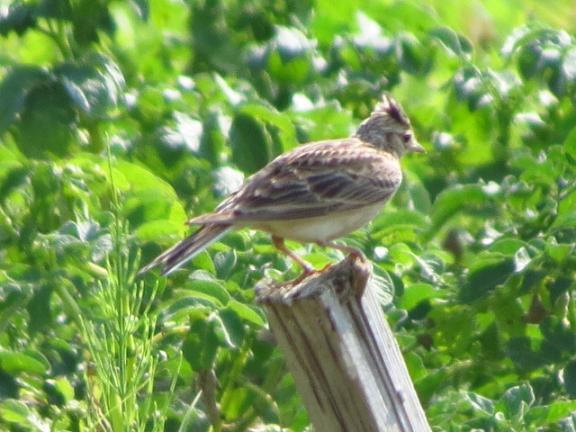
Alauda arvensis · škovránok poľný · Eurasian Skylark
Alternative and historical names
Slovak names
- škovránok poľný (Kovalik 2010)
- škovránok poľný (Matoušek 1990)
English names
- Eurasian Skylark (IOC 2.5 2010)
- Sky-Lark (BOU 1923)
Scientific names
- Alauda arvensis (AviList 2026)
- Alauda arvensis (IOC 15.2 2026)
- Alauda arvensis (IOC 2.5 2010)
- Alauda arvensis (BOU 1923)
Taxonomic synonyms
- Alauda cantarella (Bonaparte, 1841)
- Alauda arvensis Linnaeus, 1758
Birding Slovakia database
This species through our community’s eyes
Species characteristics in Slovakia
- General occurrence
- migrant / M
- Breeding
- common nidificant / Nc
- Migration
- common transmigrant / Tc
- Wintering
- uncommon wintering / Wu
- Rarities committee:
- Does not require any reporting or registration by Raritties commitee
Observation map

Detailed species observation statistics

Source: the Birding.sk database. Counts reflect observer contributions, not population size.
About this species
Distribution
Its natural range covers much of Eurasia and North Africa, with introduced populations on other continents. In Slovakia it is a widespread breeder in farmland and grassland from lowlands to mountain meadows. Flocks form during spring and autumn passage. Most birds winter farther south, although smaller numbers can remain in Slovakia.
Habitat
Typical habitats are open fields, meadows and pastures without continuous tree cover. It needs vegetation that conceals a nest while still allowing movement on the ground. Uniformly tall, dense crops throughout the season are less suitable than a varied farmland mosaic.
Breeding
The female builds an open nest in a shallow depression among vegetation, usually away from tall woody plants. A typical clutch contains 3–5 eggs. Both parents feed the young, which scatter into vegetation before they can fly and remain dependent on adults.
Food
Its diet changes through the year: insects become important during breeding, while seeds and green plant material predominate more in autumn and winter. Chicks are fed mainly invertebrates.
Interesting fact
The male delivers prolonged song while fluttering high above a field. It may become an almost invisible speck while its continuous singing fills the open space below.
Sources: Slovak Wikipedia · English Wikipedia
Sign in to send private feedback on the text to our editors.
Explore further
Overview and identification
Descriptions, identification and names.
- Slovak Wikipedia ↗
Taxon account in Slovak: distribution, biology and references for further reading.
https://sk.wikipedia.org/wiki/%C5%A0kovr%C3%A1nok_po%C4%BEn%C3%BD - English Wikipedia ↗
Taxon account in English: distribution, biology and taxonomic context.
https://en.wikipedia.org/wiki/Eurasian_skylark - Bird.watching: Eurasian Skylark – identification and voice ↗
Slovak species lesson with identification features and an example vocalisation.
https://bird.watching.sk/sk/skovranok-polny-alauda-arvensis/
Sounds, photographs and video
Recordings and visual comparisons.
- BTO: identifying Skylark and Woodlark ↗
English comparative identification video covering appearance and vocalisations.
https://www.bto.org/learn/skills/bird-identification/videos/skylark-woodlark - BTO: identifying Meadow Pipit, Tree Pipit and Skylark ↗
English comparative identification video covering appearance and vocalisations.
https://www.bto.org/learn/skills/bird-identification/videos/meadow-pipit-tree-pipit-skylark