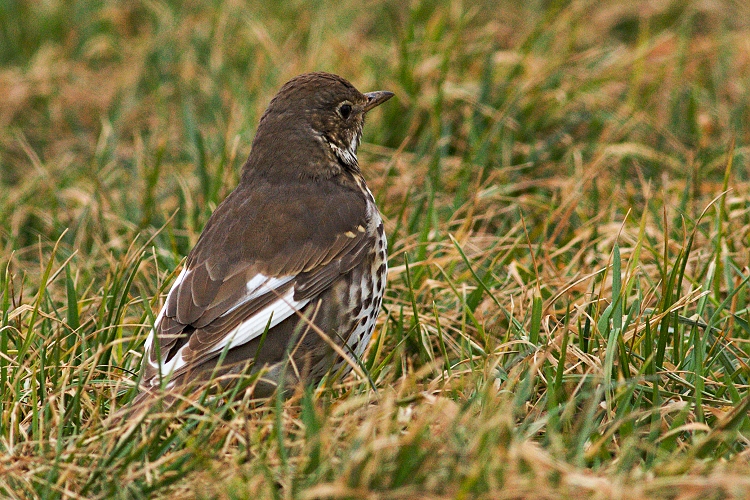
Turdus philomelos · drozd plavý · Song Thrush
Alternative and historical names
Slovak names
- drozd plavý (Kovalik 2010)
- drozd plavý (Matoušek 1990)
English names
- Song Thrush (IOC 2.5 2010)
- Song-Thrush (BOU 1923)
Scientific names
- Turdus philomelos (AviList 2026)
- Turdus philomelos (IOC 15.2 2026)
- Turdus philomelos (IOC 2.5 2010)
- Turdus philomelos (BOU 1923)
Taxonomic synonyms
- Turdus philomelos Brehm, CL, 1831
- Turdus ericetorum (Turton, 1807)
Birding Slovakia database
This species through our community’s eyes
Species characteristics in Slovakia
- General occurrence
- migrant / M
- Breeding
- common nidificant / Nc
- Migration
- common transmigrant / Tc
- Wintering
- rare wintering / Wr
- Rarities committee:
- Does not require any reporting or registration by Raritties commitee
Observation map

Detailed species observation statistics

Source: the Birding.sk database. Counts reflect observer contributions, not population size.
About this species
Distribution
It occurs across much of Europe and temperate Asia. In Slovakia it is a widespread breeding thrush from lowlands to mountain forests. Most birds migrate, returning early in spring and leaving in autumn. Individuals may winter in favourable conditions, but winter records are less routine than those of Blackbirds.
Habitat
It uses deciduous, mixed and coniferous woods, also larger gardens and parks with dense cover. Shrubby nest sites and accessible ground invertebrates are important. Singing from a treetop often reveals a bird that remains unobtrusive near the ground.
Breeding
The female builds a cup nest in a shrub or tree, smoothing the inside with a firm layer of plant material bound with saliva. She usually lays 3–5 spotted blue eggs. Both parents feed the young and may raise another brood during the season.
Food
It collects earthworms, insects, snails and other invertebrates, later adding berries. Some snails are opened by repeatedly striking their shells against a stone or another hard surface.
Interesting fact
Individual song phrases are repeated several times in succession. This pattern helps distinguish it from a Blackbird even when unseen; a suitable stone may also accumulate a small collection of broken snail shells.
Sources: Slovak Wikipedia · English Wikipedia · BTO BirdFacts
Sign in to send private feedback on the text to our editors.
Explore further
Overview and identification
Descriptions, identification and names.
- Slovak Wikipedia ↗
Taxon account in Slovak: distribution, biology and references for further reading.
https://sk.wikipedia.org/wiki/Drozd_plav%C3%BD - English Wikipedia ↗
Taxon account in English: distribution, biology and taxonomic context.
https://en.wikipedia.org/wiki/Song_thrush - BTO BirdFacts ↗
Biology and identification in English; population figures and trends refer to Britain.
https://www.bto.org/learn/about-birds/birdfacts/song-thrush
Sounds, photographs and video
Recordings and visual comparisons.
- BTO: identifying Redwing and Fieldfare ↗
English comparative identification video covering appearance and vocalisations.
https://www.bto.org/learn/skills/bird-identification/videos/redwing-and-fieldfare - BTO: identifying Nightingale and other night singers ↗
English comparative identification video covering appearance and vocalisations.
https://www.bto.org/learn/skills/bird-identification/videos/nightingale-and-other-night-singers - BTO: identifying Song Thrush and Mistle Thrush ↗
English comparative identification video covering appearance and vocalisations.
https://www.bto.org/learn/skills/bird-identification/videos/thrushes-song-and-mistle