Curruca nisoria · penica jarabá · Barred Warbler
Alternative and historical names
Slovak names
- penica jarabá (Kovalik 2010)
- penica jarabá (krahulcovitá) (Kovalik 2010)
- penica pásikavá (krahuľcovitá) (Kovalik 2010)
- penica jarabá (Matoušek 1990)
English names
- Barred Warbler (IOC 2.5 2010)
- Barred Warbler (BOU 1923)
Scientific names
- Curruca nisoria (AviList 2026)
- Curruca nisoria (IOC 15.2 2026)
- Sylvia nisoria (IOC 2.5 2010)
- Sylvia nisoria (BOU 1923)
Taxonomic synonyms
- Motacilla nisoria (Bechstein, 1795)
- Sylvia nisoria (Bechstein, 1792)
- Curruca nisoria (Bechstein, 1792)
Birding Slovakia database
This species through our community’s eyes
Species characteristics in Slovakia
- General occurrence
- migrant / M
- Breeding
- common nidificant / Nc
- Migration
- common transmigrant / Tc
- Rarities committee:
- Does not require any reporting or registration by Raritties commitee
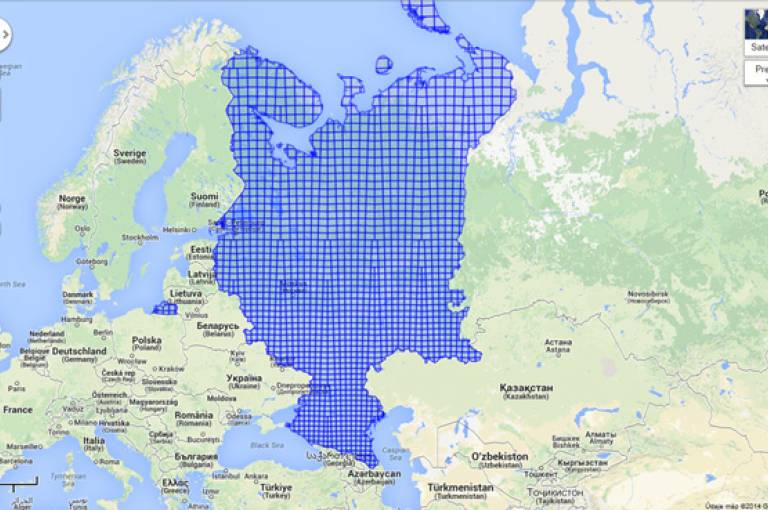
Observation map

Detailed species observation statistics

Source: the Birding.sk database. Counts reflect observer contributions, not population size.
About this species
Distribution
It breeds in central and eastern Europe and western to central Asia and winters in tropical eastern Africa. In Slovakia it regularly but unevenly occupies open scrub landscapes, chiefly warmer areas. It arrives in late spring and departs from late summer; inconspicuous juveniles may occur on passage away from typical breeding sites.
Habitat
It favours dense tall, often thorny bushes among meadows, pastures and scattered trees rather than continuous forest. Red-backed Shrikes use similar habitat, making the same landscape mosaic worth checking for both, without implying that either requires the other's presence.
Breeding
The nest is hidden in a dense shrub, usually low above the ground. A typical clutch contains 4–5 eggs. Both parents normally care for eggs and chicks, although male pairing with more than one female can alter the division of work.
Food
It takes mainly insects and other small invertebrates. Berries and soft fruits become important in late summer and autumn, contributing to migration reserves.
Interesting fact
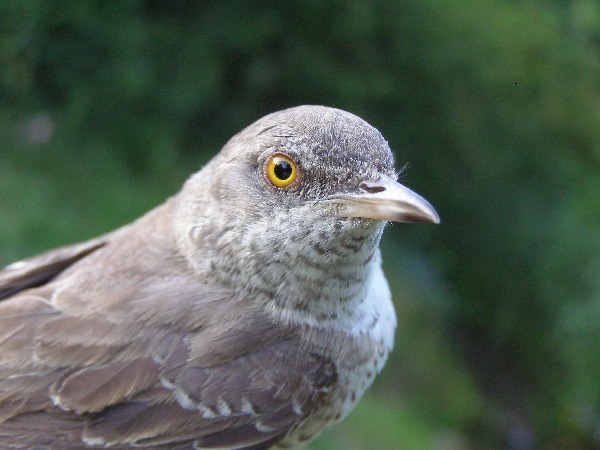
Barred underparts and a yellow eye are most conspicuous in adult males. Juveniles lack strong barring and can resemble much more ordinary brown warblers, requiring careful identification.
Sources: Slovak Wikipedia · English Wikipedia · BTO BirdFacts
Sign in to send private feedback on the text to our editors.
Explore further
Overview and identification
Descriptions, identification and names.
- Slovak Wikipedia ↗
Taxon account in Slovak: distribution, biology and references for further reading.
https://sk.wikipedia.org/wiki/Penica_jarab%C3%A1 - English Wikipedia ↗
Taxon account in English: distribution, biology and taxonomic context.
https://en.wikipedia.org/wiki/Barred_warbler - BTO BirdFacts ↗
Biology and identification in English; population figures and trends refer to Britain.
https://www.bto.org/learn/about-birds/birdfacts/barred-warbler - Bird.watching: Barred Warbler – identification and voice ↗
Slovak species lesson with identification features and an example vocalisation.
https://bird.watching.sk/sk/penica-jaraba-sylvia-nisoria/
Data and research
Occurrences, distribution and research.
- ŠOP SR: Barred Warbler – morphology and ecology ↗
Slovak state nature-conservation atlas with species morphology and ecology.
https://www.biomonitoring.sk/Registration/AtlasAnimal/Detail/48907