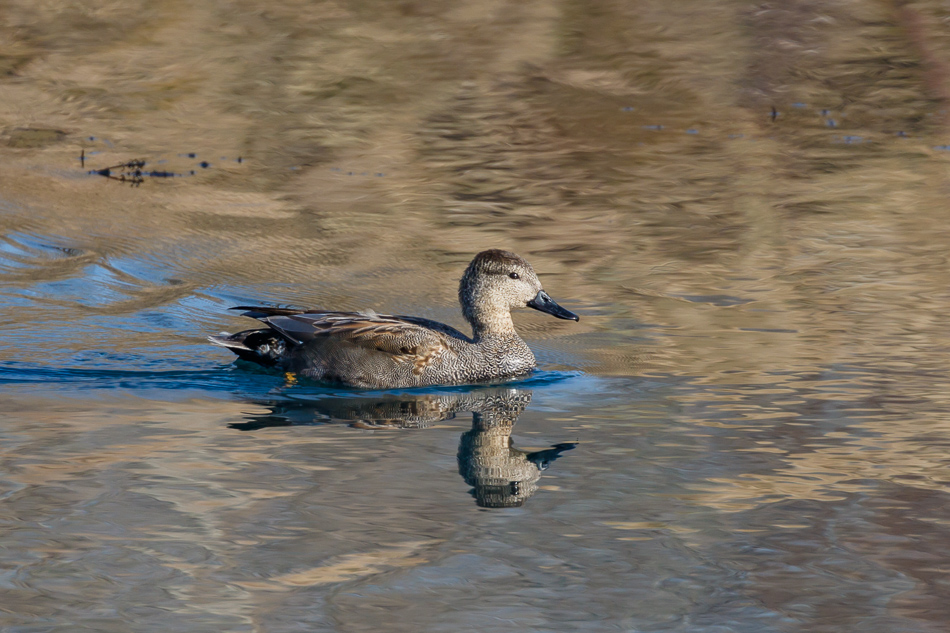
Mareca strepera · kačica chripľavka · Gadwall
Alternative and historical names
Slovak names
- kačica chripľavka (Kovalik 2010)
- chripľavka obyčajná (Kovalik 2010)
- kačica chripľavá (chripľavka) (Kovalik 2010)
- kačica chripľavá (Kovalik 2010)
- kačica chripľavá (Matoušek 1990)
English names
- Gadwall (IOC 2.5 2010)
- Gadwall (BOU 1923)
Scientific names
- Mareca strepera (AviList 2026)
- Mareca strepera (IOC 15.2 2026)
- Anas strepera (IOC 2.5 2010)
- Anas strepera (BOU 1923)
Taxonomic synonyms
- Anas strepera (Linnaeus, 1758)
- Mareca strepera (Linnaeus, 1758)
Birding Slovakia database
This species through our community’s eyes
Photographs by category
Species characteristics in Slovakia
- General occurrence
- migrant / M
- Breeding
- uncommon nidificant / Nu
- Migration
- uncommon transmigrant / Tu
- Wintering
- rare wintering / Wr
- Rarities committee:
- Does not require any reporting or registration by Raritties commitee
Observation map

Detailed species observation statistics

Source: the Birding.sk database. Counts reflect observer contributions, not population size.
About this species
Distribution
It is distributed across temperate Europe, Asia and North America. In Slovakia it is a scarce and local breeder, seen more often on passage. Smaller numbers also winter, particularly on ice-free waters. A relatively large migrant flock can contrast strongly with the small local breeding population.
Habitat
It favours shallow ponds, lakes and river arms rich in aquatic vegetation. Breeding also requires dense cover on a bank or island. On passage it uses more open reservoirs, often with other dabbling ducks and coots.
Breeding
It places its nest on the ground in grass or other dense vegetation near water. The female incubates and leads the ducklings, which leave the nest soon after hatching. Quiet overgrown margins are therefore important even where the birds are mostly seen on open water.
Food
Aquatic plants and their parts dominate its diet. Seeds and invertebrates are also taken, the latter being particularly important to growing ducklings.
Interesting fact
From a distance the male can look almost plain grey. Close views reveal delicate patterns of fine lines and scallops; the white wing patch is also a useful identification feature in both sexes.
Sources: Slovak Wikipedia · English Wikipedia · BTO BirdFacts
Sign in to send private feedback on the text to our editors.
Explore further
Overview and identification
Descriptions, identification and names.
- Slovak Wikipedia ↗
Taxon account in Slovak: distribution, biology and references for further reading.
https://sk.wikipedia.org/wiki/Ka%C4%8Dica_chrip%C4%BEavka - English Wikipedia ↗
Taxon account in English: distribution, biology and taxonomic context.
https://en.wikipedia.org/wiki/Gadwall - BTO BirdFacts ↗
Biology and identification in English; population figures and trends refer to Britain.
https://www.bto.org/learn/about-birds/birdfacts/gadwall - BTO: Identifying female dabbling ducks ↗
English identification video comparing this taxon with similar species and explaining distinguishing features.
https://www.bto.org/learn/skills/bird-identification/videos/female-dabbling-ducks