Spatula clypeata · kačica lyžičiarka · Northern Shoveler
Alternative and historical names
Slovak names
- kačica lyžičiarka (Kovalik 2010)
- lyžičiarka obyčajná (Kovalik 2010)
- lyžičiarka pestrá (Kovalik 2010)
- kačica lyžičiarka (Matoušek 1990)
- kačica lyžičiarka (Ferianc 1986)
English names
- Northern Shoveler (IOC 2.5 2010)
- Shoveler (BOU 1923)
Scientific names
- Spatula clypeata (AviList 2026)
- Spatula clypeata (IOC 15.2 2026)
- Anas clypeata (IOC 2.5 2010)
- Spatula clypeata (BOU 1923)
Taxonomic synonyms
- Anas clypeata (Linnaeus, 1758)
- Spatula clypeata (Linnaeus, 1758)
Birding Slovakia database
This species through our community’s eyes
Photographs by category
Species characteristics in Slovakia
- General occurrence
- migrant / M
- Breeding
- rare nidificant / Nr
- Migration
- common transmigrant / Tc
- Wintering
- rare wintering / Wr
- Rarities committee:
- Does not require any reporting or registration by Raritties commitee
Conservation — Red Lists
- Slovakia 2023breeding population
- Breeding population Period: 2013–2023 Source: Demko M. a kol. 2025: Červený zoznam vtákov Slovenska: aktualizácia 2013 – 2023. Tichodroma 37: 107–117. Online 18. 1. 2026. DOI: 10.31577/tichodroma.2025.37.18. Príloha 1, s. 116, riadok 4, stĺpec 6 Criteria: D
- Europe 2021
- Population scope unspecified Source: BirdLife International 2021: European Red List of Birds. Publications Office of the European Union, Luxembourg. Reported in: Demko M. a kol. 2025: Červený zoznam vtákov Slovenska: aktualizácia 2013 – 2023. Tichodroma 37: 107–117. Online 18. 1. 2026. DOI: 10.31577/tichodroma.2025.37.18. Príloha 1, s. 116, riadok 4, stĺpec 4
- World 2025
- Species Source: BirdLife International 2025: Species factsheets. Citované v Demko a kol. 2025, prístup 16. 4. 2025. Reported in: Demko M. a kol. 2025: Červený zoznam vtákov Slovenska: aktualizácia 2013 – 2023. Tichodroma 37: 107–117. Online 18. 1. 2026. DOI: 10.31577/tichodroma.2025.37.18. Príloha 1, s. 116, riadok 4, stĺpec 3
Previous assessments
- Slovakia 2013
- Breeding population Period: 2002–2012 Source: Demko M., Krištín A. & Pačenovský S. 2014: Červený zoznam vtákov Slovenska. SOS/BirdLife Slovensko, Bratislava. Zdroj stĺpca SK 2013 podľa poznámky 5 prílohy Demko a kol. 2025. Reported in: Demko M. a kol. 2025: Červený zoznam vtákov Slovenska: aktualizácia 2013 – 2023. Tichodroma 37: 107–117. Online 18. 1. 2026. DOI: 10.31577/tichodroma.2025.37.18. Príloha 1, s. 116, riadok 4, stĺpec 5 Category downgraded by 1 level due to surrounding populations.
Observation map

Detailed species observation statistics

Source: the Birding.sk database. Counts reflect observer contributions, not population size.
About this species
Distribution
It breeds in temperate and northern parts of Europe, Asia and North America and winters farther south. In Slovakia it is a regular migrant, locally more numerous on passage, but a rare breeder. Only small numbers remain on suitable ice-free waters in winter. Its presence depends on shallow wetlands with plentiful food.
Habitat
It favours shallow fishponds, flooded meadows, marshes and muddy reservoir margins. On open water it often moves with its head held low. Breeding also requires grassy or herbaceous cover around the wetland, rather than water alone.
Breeding
It hides its nest in ground vegetation, sometimes away from the shore. The female lines it with down, incubates and leads the ducklings. The male defends his surroundings during pair formation and early breeding, but the young collect their own food.
Food
Its broad bill filters small invertebrates, seeds and other fine food particles from the water. It often feeds in groups where small prey is concentrated.
Interesting fact
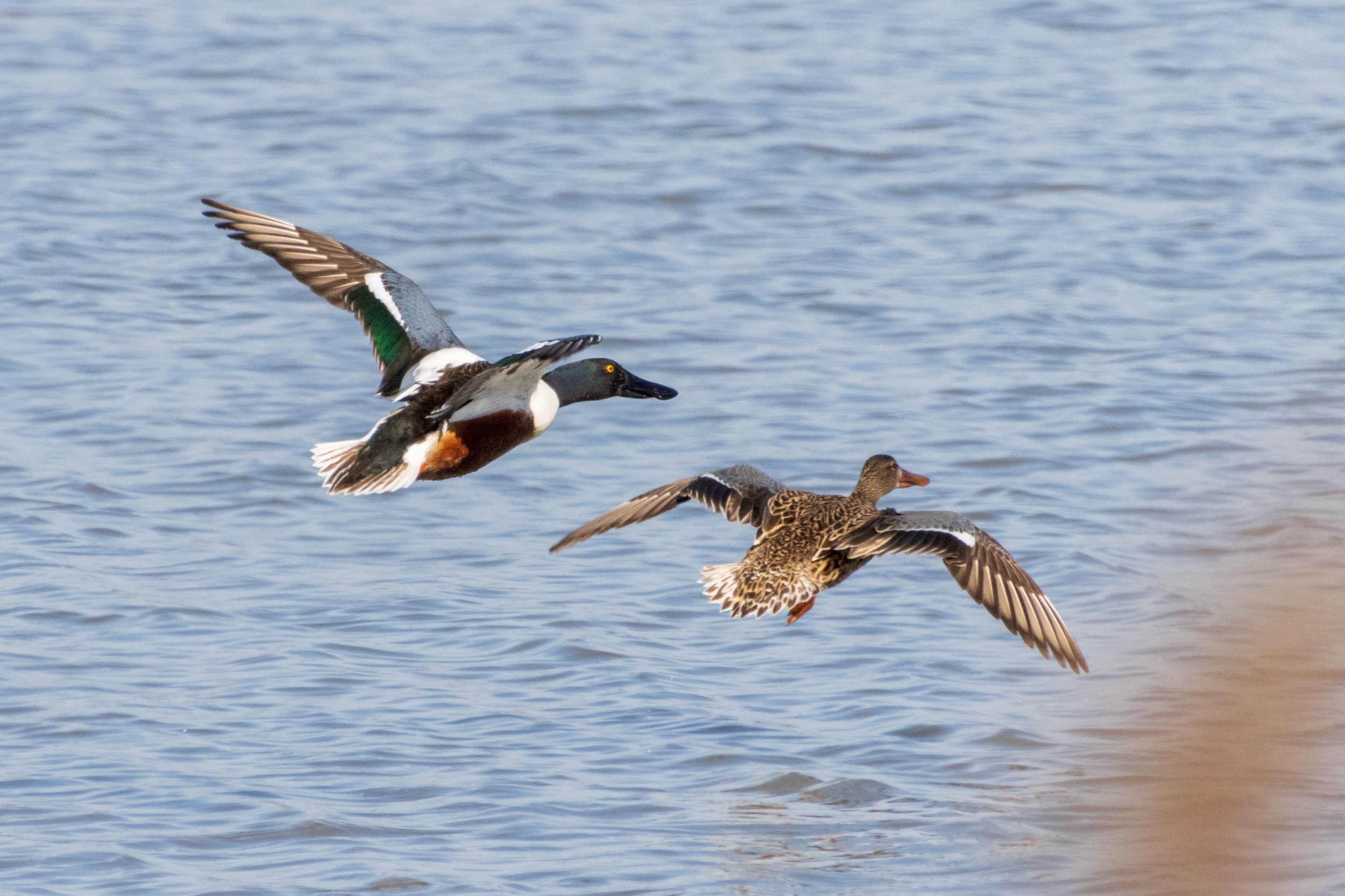
The oversized bill is not a shovel. Fine lamellae along its edges work like a sieve, retaining tiny food items while water drains away — a specialisation evident even in the bird's silhouette.
Sources: Slovak Wikipedia · English Wikipedia · BTO BirdFacts
Sign in to send private feedback on the text to our editors.
Explore further
Overview and identification
Descriptions, identification and names.
- Slovak Wikipedia ↗
Taxon account in Slovak: distribution, biology and references for further reading.
https://sk.wikipedia.org/wiki/Ka%C4%8Dica_ly%C5%BEi%C4%8Diarka - English Wikipedia ↗
Taxon account in English: distribution, biology and taxonomic context.
https://en.wikipedia.org/wiki/Northern_shoveler - BTO BirdFacts ↗
Biology and identification in English; population figures and trends refer to Britain.
https://www.bto.org/learn/about-birds/birdfacts/shoveler - BTO: Identifying female dabbling ducks ↗
English identification video comparing this taxon with similar species and explaining distinguishing features.
https://www.bto.org/learn/skills/bird-identification/videos/female-dabbling-ducks