Aythya nyroca · chochlačka bielooká · Ferruginous Duck
Alternative and historical names
Slovak names
- chochlačka bielooká (Kovalik 2010)
- chochlačka belooká (Kovalik 2010)
- chochlačka bielooká (Matoušek 1990)
- chochlačka bielooká (Ferianc 1986)
English names
- Ferruginous Duck (IOC 2.5 2010)
- White-eyed Pochard (BOU 1923)
Scientific names
- Aythya nyroca (AviList 2026)
- Aythya nyroca (IOC 15.2 2026)
- Aythya nyroca (IOC 2.5 2010)
- Nyroca nyroca (BOU 1923)
Taxonomic synonyms
- Anas nyroca (Güldenstädt, 1770)
- Nyroca nyroca (Güldenstädt, 1770)
- Aythya nyroca (Güldenstädt, 1770)
Birding Slovakia database
This species through our community’s eyes
Photographs by category
Species characteristics in Slovakia
- General occurrence
- migrant / M
- Breeding
- rare nidificant / Nr
- Migration
- uncommon transmigrant / Tu
- Wintering
- rare wintering / Wr
- Rarities committee:
- Does not require any reporting or registration by Raritties commitee
Conservation — Red Lists
- Slovakia 2023breeding population
- Breeding population Period: 2013–2023 Source: Demko M. a kol. 2025: Červený zoznam vtákov Slovenska: aktualizácia 2013 – 2023. Tichodroma 37: 107–117. Online 18. 1. 2026. DOI: 10.31577/tichodroma.2025.37.18. Príloha 1, s. 116, riadok 3, stĺpec 6 Criteria: D Category downgraded by 1 level due to surrounding populations.
- Europe 2021
- Population scope unspecified Source: BirdLife International 2021: European Red List of Birds. Publications Office of the European Union, Luxembourg. Reported in: Demko M. a kol. 2025: Červený zoznam vtákov Slovenska: aktualizácia 2013 – 2023. Tichodroma 37: 107–117. Online 18. 1. 2026. DOI: 10.31577/tichodroma.2025.37.18. Príloha 1, s. 116, riadok 3, stĺpec 4
- World 2025
- Species Source: BirdLife International 2025: Species factsheets. Citované v Demko a kol. 2025, prístup 16. 4. 2025. Reported in: Demko M. a kol. 2025: Červený zoznam vtákov Slovenska: aktualizácia 2013 – 2023. Tichodroma 37: 107–117. Online 18. 1. 2026. DOI: 10.31577/tichodroma.2025.37.18. Príloha 1, s. 116, riadok 3, stĺpec 3
Previous assessments
- Slovakia 2013
- Breeding population Period: 2002–2012 Source: Demko M., Krištín A. & Pačenovský S. 2014: Červený zoznam vtákov Slovenska. SOS/BirdLife Slovensko, Bratislava. Zdroj stĺpca SK 2013 podľa poznámky 5 prílohy Demko a kol. 2025. Reported in: Demko M. a kol. 2025: Červený zoznam vtákov Slovenska: aktualizácia 2013 – 2023. Tichodroma 37: 107–117. Online 18. 1. 2026. DOI: 10.31577/tichodroma.2025.37.18. Príloha 1, s. 116, riadok 3, stĺpec 5 Category downgraded by 1 level due to surrounding populations.
Observation map

Detailed species observation statistics

Source: the Birding.sk database. Counts reflect observer contributions, not population size.
About this species
Distribution
Its scattered range extends from southern and eastern Europe to western and central Asia, with wintering areas also in Africa and southern Asia. In Slovakia it is a rare breeder in lowland wetlands. It also occurs on passage, while wintering is scarce and irregular. Many Slovak observations come from rich, overgrown waters.
Habitat
It favours shallow fishponds, marshes and river arms with dense vegetation and gaps of open water. It often stays closer to cover than the commoner diving ducks. Carefully scanning reed edges and mixed duck groups is therefore more useful than watching only the middle of a lake.
Breeding
The nest is hidden in vegetation immediately beside water or built on plant material above the surface. The female incubates and accompanies the young. Wetland drying and removal of marginal cover reduce suitable breeding habitat.
Food
It takes aquatic plants, seeds and small water animals, including molluscs and insects. It dives for food but can also feed near the surface.
Interesting fact
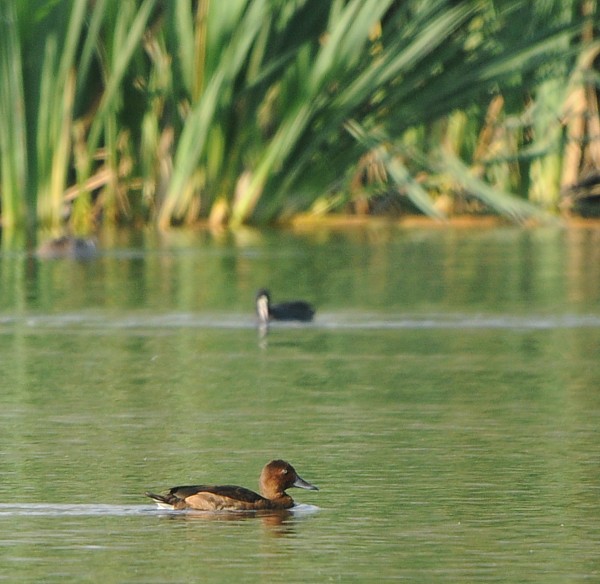
The pale eye reflected in its Slovak name is most typical of the adult male. Females and young birds have darker eyes, so head shape, brown plumage and white undertail coverts also matter for identification.
Sources: Slovak Wikipedia · English Wikipedia · BTO BirdFacts
Sign in to send private feedback on the text to our editors.
Explore further
Overview and identification
Descriptions, identification and names.
- Slovak Wikipedia ↗
Taxon account in Slovak: distribution, biology and references for further reading.
https://sk.wikipedia.org/wiki/Chochla%C4%8Dka_bielook%C3%A1 - English Wikipedia ↗
Taxon account in English: distribution, biology and taxonomic context.
https://en.wikipedia.org/wiki/Ferruginous_duck - BTO BirdFacts ↗
Biology and identification in English; population figures and trends refer to Britain.
https://www.bto.org/learn/about-birds/birdfacts/ferruginous-duck
Data and research
Occurrences, distribution and research.
- Slovak recovery programme: Bittern and Ferruginous Duck 2024–2028 ↗
Slovak expert recovery programme for both species, covering wetland habitats, threats and practical measures for 2024–2028.
https://www.minzp.sk/files/sekcia-ochranyprirodyakrajiny/druhova-ochrana-prirody/programy-zachrany/program_zachrany_buciak_chochlacka-roky-2024-2028.pdf - AEWA/CMS: Ferruginous Duck conservation action plan ↗
English expert conservation plan for Ferruginous Duck, analysing threats and actions; a historical international reference.
https://www.unep-aewa.org/sites/default/files/publication/ts7_ssap_ferruginous_duck_complete_1.pdf - State Nature Conservancy: identification, ecology and conservation – Aythya nyroca ↗
Slovak expert profile with morphology, ecology and species conservation information.
https://www.biomonitoring.sk/Registration/AtlasAnimal/Detail/48612