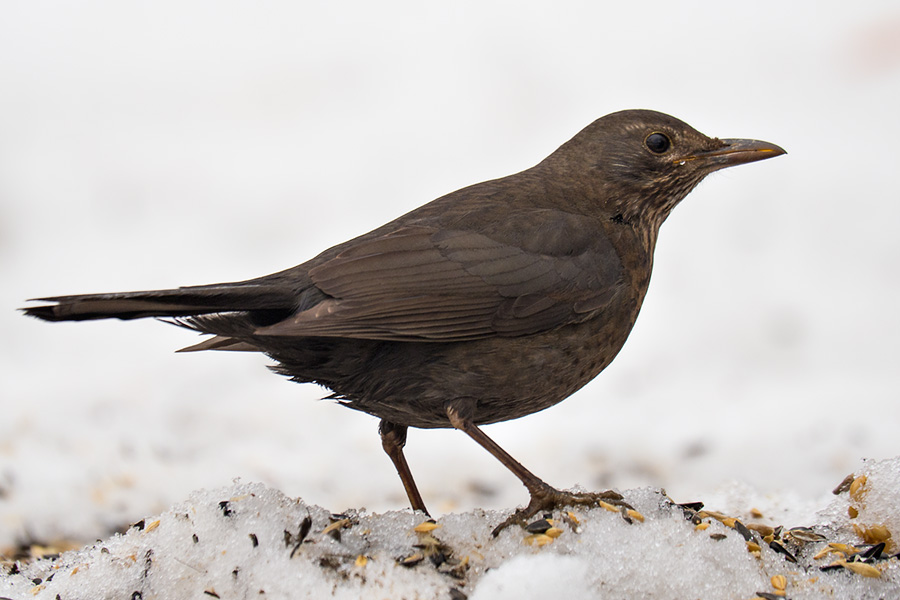
Turdus merula · drozd čierny · Common Blackbird
Alternative and historical names
Slovak names
- drozd čierny (Kovalik 2010)
- drozd čierny (Matoušek 1990)
English names
- Common Blackbird (IOC 2.5 2010)
- Blackbird (BOU 1923)
Scientific names
- Turdus merula (AviList 2026)
- Turdus merula (IOC 15.2 2026)
- Turdus merula (IOC 2.5 2010)
- Turdus merula (BOU 1923)
Taxonomic synonyms
- Turdus merula Linnaeus, 1758
Birding Slovakia database
This species through our community’s eyes
Species characteristics in Slovakia
- General occurrence
- some are resident, some are migratory / R+M
- Breeding
- common nidificant / Nc
- Migration
- common transmigrant / Tc
- Wintering
- common wintering / Wc
- Rarities committee:
- Does not require any reporting or registration by Raritties commitee
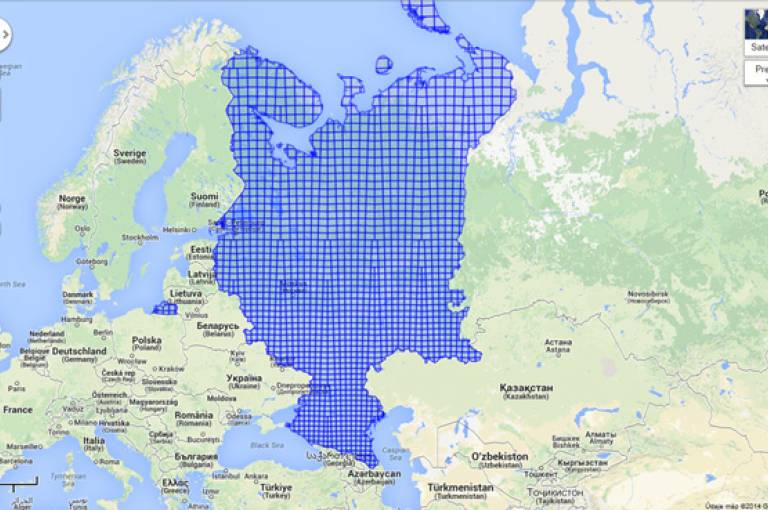
Observation map

Detailed species observation statistics

Source: the Birding.sk database. Counts reflect observer contributions, not population size.
About this species
Distribution
The Blackbird's natural range extends from Europe and north-west Africa into parts of Asia; people have also introduced it to Australia and New Zealand. In Slovakia it is a widespread breeding bird, from the lowlands to mountain forests. It can be seen throughout the year, although part of the population leaves for the winter. During the colder months it is particularly conspicuous in settlements and at lower elevations.
Habitat
It inhabits woodland with undergrowth, scrubby edges, gardens, parks and urban courtyards. Look for it on lawns and among fallen leaves beside bushes. A combination of food on the ground and nearby dense cover is important.
Breeding
Its cup-shaped nest, made from stems and other plant material, is reinforced with mud. It places the nest in shrubs, trees or on sheltered ledges. It usually lays three to five eggs and may raise several broods over spring and summer. Parents continue feeding their young after they leave the nest.
Food
It searches the ground for earthworms, insects and other invertebrates. Berries and soft fruit become more important from late summer; winter fruits help it through periods when the ground is frozen.
Interesting fact
The Blackbird was originally mainly a woodland bird. Its successful colonisation of towns shows how a species can adapt to human landscapes. Even in a busy street, however, it still relies on bushes, soil and leaf litter for food and shelter.
Sources: Slovak Wikipedia · BTO BirdFacts · English Wikipedia
Sign in to send private feedback on the text to our editors.
Explore further
Overview and identification
Descriptions, identification and names.
- Slovak Wikipedia ↗
Taxon account in Slovak: distribution, biology and references for further reading.
https://sk.wikipedia.org/wiki/Drozd_%C4%8Dierny - BTO BirdFacts ↗
Biology and identification in English; population figures and trends refer to Britain.
https://www.bto.org/learn/about-birds/birdfacts/blackbird - English Wikipedia ↗
Taxon account in English: distribution, biology and taxonomic context.
https://en.wikipedia.org/wiki/Common_blackbird
Sounds, photographs and video
Recordings and visual comparisons.
- BTO: identifying Nightingale and other night singers ↗
English comparative identification video covering appearance and vocalisations.
https://www.bto.org/learn/skills/bird-identification/videos/nightingale-and-other-night-singers - BTO: identifying Ring Ouzel and Blackbird ↗
English comparative identification video covering appearance and vocalisations.
https://www.bto.org/learn/skills/bird-identification/videos/ring-ouzel-and-blackbird