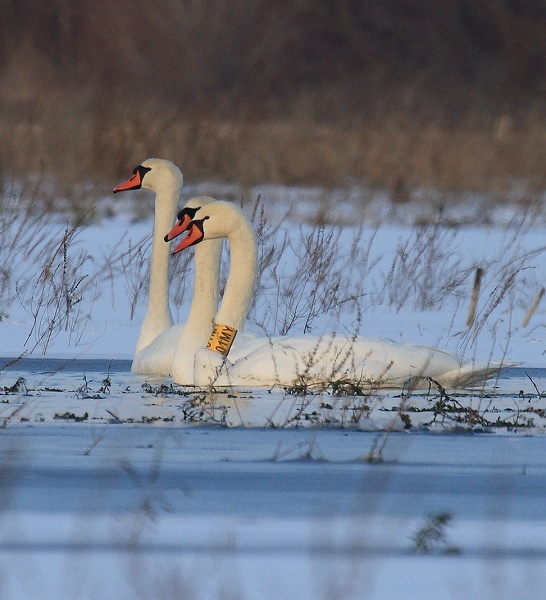
Cygnus olor · labuť veľká · Mute Swan
Alternative and historical names
Slovak names
- labuť veľká (Kovalik 2010)
- labuť hrbozobá (Kovalik 2010)
- labuť hrbozobá (Matoušek 1990)
- labuť veľká (Ferianc 1986)
English names
- Mute Swan (IOC 2.5 2010)
- Mute Swan (BOU 1923)
Scientific names
- Cygnus olor (AviList 2026)
- Cygnus olor (IOC 15.2 2026)
- Cygnus olor (IOC 2.5 2010)
- Cygnus olor (BOU 1923)
Taxonomic synonyms
- Anas olor (J.F.Gmelin, 1789)
- Cygnus olor (Gmelin, JF, 1789)
Birding Slovakia database
This species through our community’s eyes
Species characteristics in Slovakia
- General occurrence
- some are resident, some are migratory / R+M
- Breeding
- uncommon nidificant / Nu
- Migration
- common transmigrant / Tc
- Wintering
- common wintering / Wc
- Rarities committee:
- Does not require any reporting or registration by Raritties commitee
Observation map

Detailed species observation statistics

Source: the Birding.sk database. Counts reflect observer contributions, not population size.
About this species
Distribution
Its native range lies in Europe and parts of Asia, and people have introduced it to other continents. In Slovakia it is a common and familiar waterbird, especially in the lowlands. It breeds on many suitable waters and occurs year-round; larger gatherings can form in winter and during moult.
Habitat
It inhabits ponds, lakes, reservoirs, river arms and urban waters. Accessible plant food and a quiet place for nesting or resting are important. It may also graze waterside lawns and fields, rather than relying entirely on aquatic vegetation.
Breeding
The pair builds a substantial mound of plants on a bank, island or in shallow water. The female performs most incubation, but both parents lead and protect the cygnets. A nesting pair often vigorously defends its surroundings.
Food
Its diet is mainly plant material: aquatic vegetation, grasses and crops. The long neck lets it reach below the surface without submerging its whole body.
Interesting fact
The name Mute Swan does not mean it is silent. It hisses and gives other subdued calls; in flight, the characteristic rhythmic sound of its wings may reveal an approaching bird before it comes into view.
Sources: Slovak Wikipedia · English Wikipedia · BTO BirdFacts
Sign in to send private feedback on the text to our editors.
Explore further
Overview and identification
Descriptions, identification and names.
- Slovak Wikipedia ↗
Taxon account in Slovak: distribution, biology and references for further reading.
https://sk.wikipedia.org/wiki/Labu%C5%A5_ve%C4%BEk%C3%A1 - English Wikipedia ↗
Taxon account in English: distribution, biology and taxonomic context.
https://en.wikipedia.org/wiki/Mute_swan - BTO BirdFacts ↗
Biology and identification in English; population figures and trends refer to Britain.
https://www.bto.org/learn/about-birds/birdfacts/mute-swan