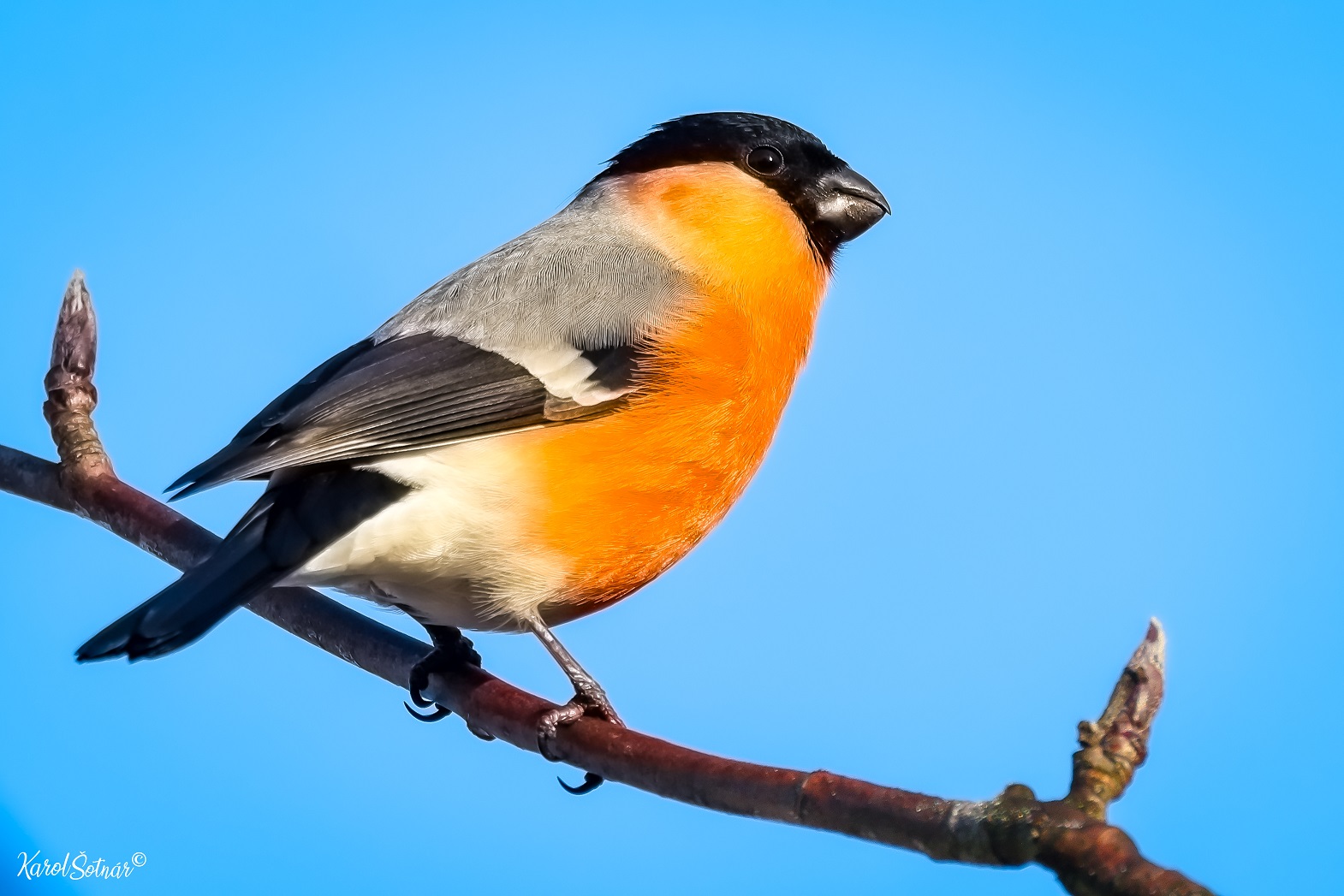
Pyrrhula pyrrhula · hýľ obyčajný · Eurasian Bullfinch
Alternative and historical names
Slovak names
- hýľ obyčajný (Kovalik 2010)
- hýľ lesný (Kovalik 2010)
- hýľ lesný (Matoušek 1990)
English names
- Eurasian Bullfinch (IOC 2.5 2010)
- Bullfinch (BOU 1923)
Scientific names
- Pyrrhula pyrrhula (AviList 2026)
- Pyrrhula pyrrhula (IOC 15.2 2026)
- Pyrrhula pyrrhula (IOC 2.5 2010)
- Pyrrhula pyrrhula (BOU 1923)
Taxonomic synonyms
- Emberiza coccinea (Gmelin, 1789)
- Pyrrhula pyrrhula coccinea (Gmelin, 1789)
- Loxia pyrrhula (Linnaeus, 1758)
- Loxia spec (Linnaeus, 1758)
- Pyrrhula pyrrhula (Linnaeus, 1758)
Birding Slovakia database
This species through our community’s eyes
Photographs by category
Species characteristics in Slovakia
- General occurrence
- mainly resident, minority is migratory / R(M)
- Breeding
- common nidificant / Nc
- Migration
- common transmigrant / Tc
- Wintering
- common wintering / Wc
- Rarities committee:
- Does not require any reporting or registration by Raritties commitee
Observation map

Detailed species observation statistics

Source: the Birding.sk database. Counts reflect observer contributions, not population size.
About this species
Distribution
The Bullfinch occupies wooded regions of Europe and Asia. In Slovakia it breeds mainly at middle and mountain elevations, particularly in the central and eastern parts of the country. It is largely resident, but winter dispersal to lower elevations and arrivals from the north make its winter distribution much wider than its breeding range.
Habitat
It favours woodland with dense undergrowth, young conifers, edges and scrub. In winter it visits gardens, orchards and parks offering fruit and buds. A soft, low whistle often reveals birds moving between trees.
Breeding
The nest of fine twigs is hidden in a dense bush or conifer. Usually 4–6 eggs are laid. The female incubates while the male feeds her, and both later provision the chicks; breeding may be repeated.
Food
Seeds, buds and fruits dominate. When processing berries it is often especially interested in the seeds inside; invertebrates are also brought to chicks.
Interesting fact
The striking pink-red breast belongs to the male, not every Bullfinch. Females have grey-brown underparts but share the black cap and white rump that flashes briefly as they fly away.
Sources: Slovak Wikipedia · English Wikipedia · BTO BirdFacts
Sign in to send private feedback on the text to our editors.
Explore further
Overview and identification
Descriptions, identification and names.
- Slovak Wikipedia ↗
Taxon account in Slovak: distribution, biology and references for further reading.
https://sk.wikipedia.org/wiki/H%C3%BD%C4%BE_oby%C4%8Dajn%C3%BD - English Wikipedia ↗
Taxon account in English: distribution, biology and taxonomic context.
https://en.wikipedia.org/wiki/Eurasian_bullfinch - BTO BirdFacts ↗
Biology and identification in English; population figures and trends refer to Britain.
https://www.bto.org/learn/about-birds/birdfacts/bullfinch