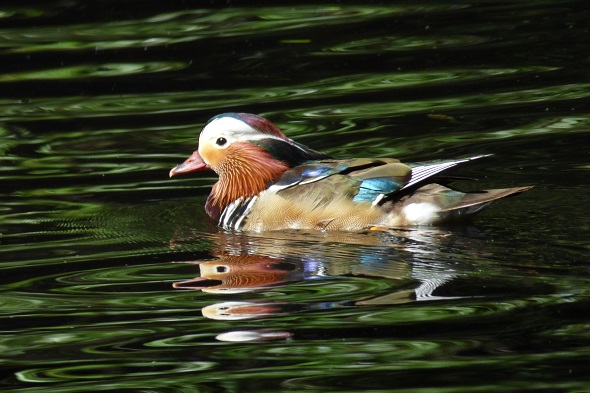
Aix galericulata · kačička mandarínska · Mandarin Duck
Alternative and historical names
Slovak names
- kačička mandarínska (Kovalik 2010)
- kačica mandarínska (Kovalik 2010)
- kačička mandarínska (bradatá) (Kovalik 2010)
- kačička mandarínska (mandarínka) (Kovalik 2010)
- kačica mandarínska (Matoušek 1990)
- kačička mandarínska (Ferianc 1986)
English names
- Mandarin Duck (IOC 2.5 2010)
Scientific names
- Aix galericulata (AviList 2026)
- Aix galericulata (IOC 15.2 2026)
- Aix galericulata (IOC 2.5 2010)
Taxonomic synonyms
- Anas galericulata (Linnaeus, 1758)
- Aix galericulata (Linnaeus, 1758)
Birding Slovakia database
This species through our community’s eyes
Species characteristics in Slovakia
- Breeding
- rare nidificant / Nr
- Migration
- uncommon transmigrant / Tu
- Wintering
- uncommon wintering / Wu
- Rarities committee:
- Sigthings of this specie are registered by Raritties commitee
Conservation — Red Lists
- Slovakia 2023breeding population
- Breeding population Period: 2013–2023 Source: Demko M. a kol. 2025: Červený zoznam vtákov Slovenska: aktualizácia 2013 – 2023. Tichodroma 37: 107–117. Online 18. 1. 2026. DOI: 10.31577/tichodroma.2025.37.18. Výsledky, s. 112, výslovne menovaný druh Druh uvedený v texte medzi 19 druhmi NA.
Observation map

Detailed species observation statistics

Source: the Birding.sk database. Counts reflect observer contributions, not population size.
About this species
Distribution
The Mandarin Duck is native to East Asia. Free-living European populations originated from captive birds and their descendants. In Slovakia it occurs irregularly on various waters, with individual breeding attempts documented. The official December 2024 checklist gives categories C and E; records should therefore be considered in relation to introduced populations and escapes, rather than ordinary migration from Asia.
Habitat
It favours quiet river stretches and smaller waters with trees, overhanging branches and sheltered margins. In Slovakia it can occur on rivers, park ponds and winter gatherings of waterbirds. Resting birds often hide under waterside vegetation.
Breeding
It nests in a tree cavity or spacious nest box. The female usually lays 9–12 eggs, incubates and leads the brood. Soon after hatching the ducklings jump from the tree and move to water.
Food
It eats seeds, acorns, aquatic plants and invertebrates. Their relative importance varies with season and availability at each site.
Interesting fact
The male’s upright orange wing feathers resemble sails. These are absent in its post-breeding eclipse plumage, so identification in summer requires a closer look.
Sources: Slovak Wikipedia · English Wikipedia · BTO BirdFacts · Records Committee: Slovak checklist, 2024
Sign in to send private feedback on the text to our editors.
Explore further
Overview and identification
Descriptions, identification and names.
- Slovak Wikipedia ↗
Taxon account in Slovak: distribution, biology and references for further reading.
https://sk.wikipedia.org/wiki/Ka%C4%8Di%C4%8Dka_mandar%C3%ADnska - English Wikipedia ↗
Taxon account in English: distribution, biology and taxonomic context.
https://en.wikipedia.org/wiki/Mandarin_duck - BTO BirdFacts ↗
Biology and identification in English; population figures and trends refer to Britain.
https://www.bto.org/learn/about-birds/birdfacts/mandarin-duck - Records Committee: Slovak checklist, 2024 ↗
Official checklist and occurrence categories as of December 2024; XLSX file.
https://www.vtaky.sk/media/Zoznam_vtakov_Slovenska_IOC_december_2024.xlsx - BTO: Identifying Mandarin and Wood Duck ↗
English identification video comparing this taxon with similar species and explaining distinguishing features.
https://www.bto.org/learn/skills/bird-identification/videos/mandarin-and-wood-duck